
Bonnie Smart
Selection of Works from 2021
(MADT301) "Infinity island" - still images, 2021


Screenshots from Infinity Island - built with Sketchup (some rendered through Vector extensions), edited with Photoshop.
Artist Statement
Infinity Island is a work that explores psychedelic art, architecture, surrealism, and physics. For my recent projects I am leading myself in a new direction of entrepreneurialism, where I can bridge the worlds of art and architecture. John Hartley explores the philosophy of storytelling in “Paradigm shifters: tricksters and cultural science”; he writes about how “mythological tricksters give us material to think with, specifically about the relationship between system and agency in order to theorise change.” (p5)
This 3D model was inspired by video-game design, post-apocalyptic sciencefiction/fantasy films, as well as real-world concepts that have either been realized or are still in progress. In Milan, architect Stefano Boeri’s prototypes for “smog-eating, vertical forests” were built, while in search of environmental solutions to pollution. Since the construction of the first of these plant-covered towers in 2017, many versions have also been conceived in China. (Gibson) Trickster practice is strong in my experiments, with the use of photoshop. To me, it is an illusionist’s tool. I repurpose found objects and create digital tiles that cover the walls of my building prototypes. The tiles came from photographs of a Chinoiserie-style vase. Using replicas of replicas is important to my concept of the infinity. This excerpt in “From Understanding to Creating Curriculum” describes just that phenomenon, both in artwork and psychology:
“Postmodernism articulates this as the death of the subject, the repudiation of outside reality and meta-narratives, the illusion of language, and the failure of rationality to understand the world. It has led to an imagistic world overloaded with information where a crisis of representation means there are only copies, images for which no original exists (similacrum), resulting in endless commodification and consumerism. The unity of the self is replaced by multiple selves.” (Grimmet & Halvorson, p246)
This research is driven by fascination with the hermeneutic loop; the idea is that I want Infinity Island to read as self-referencing. My imagination is alive with the playfulness of the inner child. Due to an overactive mind, I tend to crawl up the walls and lose my mind a bit, searching for connections or solutions. I want to give my audience that feeling of being a kid, laying on your back and pretending to walk on the ceiling, through the thresholds at entryways. I am influenced by ideas of the geometrically sound, but physically impossible through work like Maurit C. Escher’s. I can relate to him in that he had a very compulsive mind and arrived at some complicated mathematical solutions simply by following his own intuition. (“The Art of The Impossible”, 00:14:34) A parallel I realized between my own work and his is this obsession with placing tiles in infinite patterns. (“The Art of The Impossible”, 00:13:56) He referred to it as “regular division of the plane”.
Throughout the phases of this project, I have featured my paintings as repetitive background murals. For the piece shown in "Termite Edition", I followed the wood grain on a piece of plywood panel, much like how a paint-by-number dictates. Sometimes the materials suggest what methods should be applied, and I allow myself to work intuitively through a variety of media.
I believe this work explores human-environment relationships, without the presence of definitively human characters; nearly every surface is covered in organic patterns, and even the plant-life on Infinity Island grows arms, legs, and heads. It could be perceived as both a sustainable building model and even a post-human world. These instances allow the viewer to reflect on human participation on our planet, by presenting them with an imaginary one. “Animism is a combination of Shintoism and Buddhism and accepts that deity/kami exists in all beings. Shinto stresses relation and connectedness, emphasizing internal over external relations, where each part is reflected in the whole, and the whole is evident in every part.” (qtd. In Mumcu & Yilmaz, p5)
(MADT301) "Infinity island" - still images (Process shots), 2021


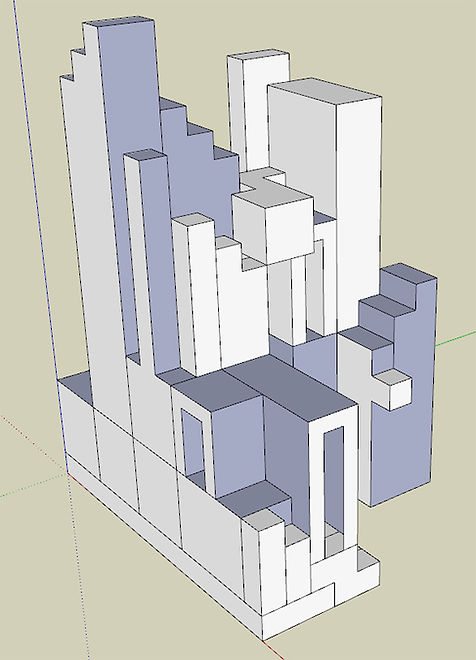
Screenshots from Infinity Island - built with Sketchup (some rendered through Vector extensions), edited with Photoshop.
Works Cited:
Gibson, Eleanor. “Stefano Boeri designs ‘vertical forest’ city to eat up China’s smog”. Dezeen, 2017. https://www.dezeen.com/2017/06/28/liuzhou-forest-city-stefano-boeriproposes-plant-covered-city-to-eat-up-chinas-smog/. Accessed: March 4, 2021.
Grimmet, Peter P., and Mark Halvorson. “From Understanding to Creating Curriculum: The Case for the Co-Evolution of Re-Conceptualized Design With Re-Conceptualized Curriculum.” An essay review of Understanding Curriculum: An Introduction to the Study of Historical and Contemporary Curriculum Discourses. Pinar, W.F., Reynolds, W.M., Slattery, P., & Taubman, P.M. New York: Peter Lang, 1995/2003). Published by: Simon Fraser University, Surrey, BC, Canada. pp241-262.
Hartley, John. “Paradigm shifters: tricksters and cultural science.” Published by: ARC Centre of Excellence for Creative Industries & Innovation, QUT, Australia. 2010. pp1-18.
Mumcu, Sema, and Serap Yilmaz. “Anime Landscapes as a Tool for Analyzing the Human-Environment Relationship: Hayao Miyazaki Films.” Published by: Landscape Architecture Department, Faculty of Forestry, Karadeniz Technical University, Trabzon, Turkey. April 17th, 2-18.
“Natural History of the Enigma”. Eduardo Kac. Accessed Mar 3, 2021. URL: https://www.ekac.org/nat.hist.enig.html
“The Art of the Impossible: MC Escher and Me – Secret Knowledge.” YouTube, uploaded by Art Documentaries, September 2015, https://www.youtube.com/watch?v=f7kW8xd8p4s (Part 1), https://www.youtube.com/watch?v=1CYrGpd8k5w (Part 2).
(madt301) "cadmares", 2021

"CADmares", 2021. Finished installation: with custom pillow case (sewn from bedsheets) with 8 colors of thread, crocheted blanket and large fun-furred, circular pillow. Custom pillow: 25"x17.5"x2", Blanket: 46"x43.5", circular pillow: 55" dia. x 3" thick.

(Detail 1) "CADmares", 2021. Custom pillow case (sewn from bedsheets) with 8 colors of thread. 25"x17.5"x2".
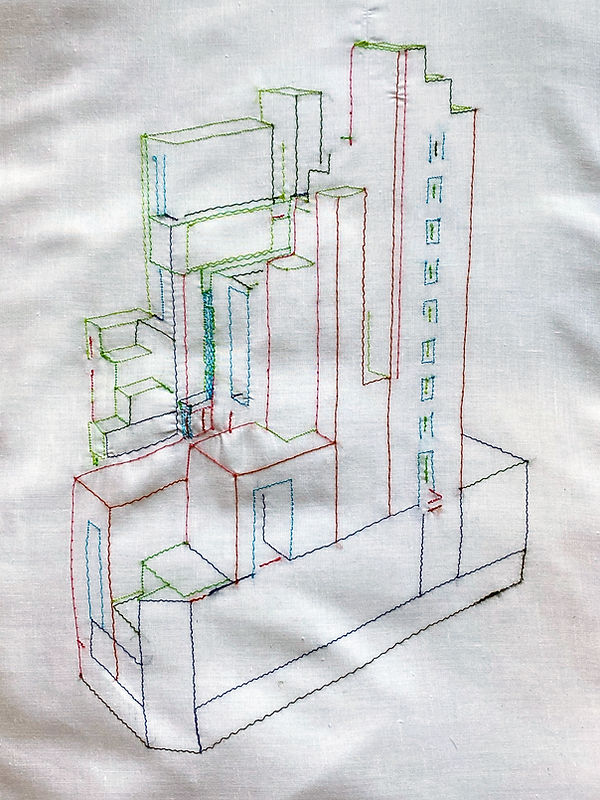
(Detail 2) "CADmares", 2021.
(Detail 2) "CADmares", 2021.

Edited photo of "CADmares" submersed in bathtub, during sewing process, 2021.
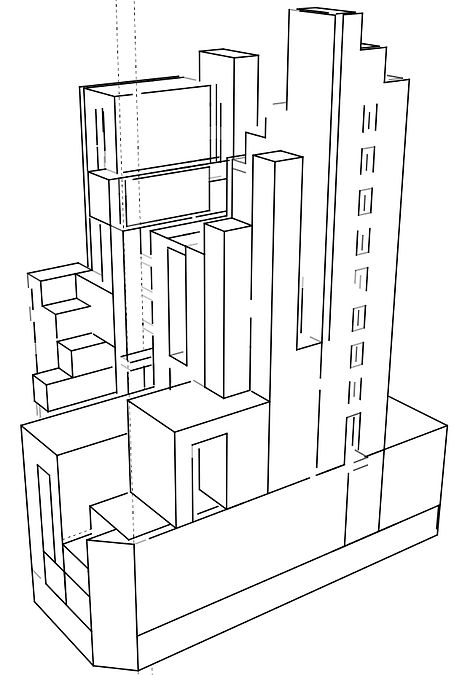


Screenshots from Infinity Island model in Sketchup. Line drawing on far left was used for "CADmares" template during machine sewing of final work. 3 other screenshots included to show potential future projects.
Artist Statement
CADmares are what my technologist peers call their nightmares, when they have been spending endless hours working on a project and the images begin to burn themselves into their minds. We would share stories about falling in a dark model space, where there was no ceiling and no floor; in some cases, places that would defy physics. Sometimes in these dreams we were pulled by marionette strings that would reach to oblivion. In most of these dark fantasies we would be obsessing over details of the work that had absolutely consumed us; inevitably storing those problems in our subconscious, where we could continue to chase them. The CADmare is something that bonds people who have dedicated themselves to achieving goals in techno-space, reaching a point of near or absolute insanity. We all want to be hirable, but beyond that we want to be efficient so that people want to keep us around. The only way to reach that efficiency is to keep up with a world (both real and abstract) that is ever-changing. That is the geek’s manifesto. Once you go down that path, it is hard to stop. The idea of stopping means losing the momentum that has been carrying you through all the nights you lost sleep. The less you practice, the less you stay afloat.
I used the same model that I had used for the “Infinity Island” photos and videos and edited them to the point where they were suitable for 3D printing (meaning water-tight, perfect geometry, proper supports). I outsourced the printing itself, as I do not have access to a 3D printer. There would be a couple weeks wait time to have it shipped back to me, but I did not want the work to come to a halt. At this point, I was very invested in the work. I felt an urge to continue along this trajectory I had started. I began to ask myself what else I had in my wheelhouse and how I could bring this project back to a place where it was tangible. Embroidery, although delicate, invites us to touch.
The eight different colors of thread (black, navy, cyan, chartreuse, med-green, dark-green, pink and red) are inspired by layering conventions used when working with CAD software. I printed the screenshots from my model onto 11” x 17” sheets, which seemed appropriate for a standard architectural drawing size. These were used as templates, as I meticulously sewed the lines onto the bedsheets. I was reminded of the underwater scene from my video rendering for the project, as I soaked the paper from the fabric. The three different colors of green swirled around the organic roof, like kelp. Mesmerized by this, I snapped a photograph.
Every step of this project told a different story: from processing, to processed, to post-processed. “CADMares” has an embroidered look with the multi-colored threads. However, a traditional sewing machine was used the same way I used a computer to arrive at the first stage of the work. I could hear my prof’s words in my head: “there is more than one way to draw a line, there is more than one way to pull a wall. Work smarter, not harder.” Then naturally, the underwater scene goes back to the computer. To make it more and less real, simultaneously. To challenge perception and play with my viewer.
The final product of “CADMares” was sewn into a pillow and thrown atop a pillowtop with a blanket. It is meant to reflect on this time that I have pushed myself to extremes. Learned so much new software, and so many new applications, took so many new paths – all while nurturing the little baby boy growing inside of me. Now, I can finally rest my head. This work is meant to be viewed while laying on the floor – embracing and awakening the inner child. Hopefully, I can wake up with these lines imprinted in my face. I could then document those. And so, one thing flows into the next: the infinite.
(madt301) "kaleidoscope edits - 3d model of infinity island", 2021


Unedited photos of Infinity Island 3D model (black natural versatile plastic) and inspiration vase, using kaleidoscope lens for IPhone, mirror. 2021.
Vase: 14"high with 5.5" lip and 4.5" base, model: 4"x3"x2".
Artist Statement
Kaleidoscope Edits was intended to mirror the work that I had produced in the 3D realm for Infinity Island. The model itself is made from black versatile natural plastic and is less than a third of the size of the vase that I used to create the digital tiles that cover the walls of the model, within Sketchup. I placed the miniature island on a mirror pane, with the vase in the background. That way, the patterns and the formations of this real-world island are matching the computer-rendered version.
The kaleidoscope lens was imperative to the documentation too. Escher’s work was a subconscious influence to this work. The more I investigated Escher’s pieces and his own inspirations, the more I began to draw parallels between the way we were working through problems. It was almost as if we were alongside one another. First, there was the way Escher would create tessellations: repetitive patters with no gaps or spaces. I had intuitively done this as well when I made my infinity tiles. Apparently, Escher was sent a diagram from the famous geometer, Professor Coxeter. In this diagram, the point of infinity was expressed at the outward point of a sphere, looking like a horizon on water. Escher had already been working through these problems, but Coxeter just pushed him along to further this exploration. “Coxeter groups” are algebraic equations that express how objects appear through a kaleidoscope. (Strauss) I discovered this of course, after I had recently started experimenting with a kaleidoscope lens for my smart phone. I was just drawn to the effect of seeing the image multiply.
Escher explained he would “latch onto mathematical theories without realizing it was happening.” I would say that I am a big lover of math, and that I use it as a tool when I create art. Working as an estimator for many years, I can multiply, divide and make conversions rather quickly off the top of my head.
In “MC Escher and I: The Secret Knowledge”, scientist Robert Penrose explains that Escher had seen an article written by a mathematician that showed 17 different planes of symmetry groups used by scientists studying crystal structures. Inspired by this and the Moorish tiles in Spain, Escher began drawing his own diagrams, and eventually those turned into creatures from his own imagination: butterflies, fish, snakes. The artist referred to this as the “regular division of the plane” and the method began appearing in the titles of his work starting in 1937. This obsession became his passion and he kept following that intuition for his remaining career, and life.
I like to think that my current exploration is the beginning of something greater, for my own career. I am not sure this exploration has a finish line, and it began with my work Community Pool in 2020. I am endlessly fascinated by the research and the products that came from this Infinity Island, and for me what that truly reflects is potential. I see now that I can be a realist and a dreamer; that this is exactly who I am meant to be.

Edited photos of kaleidoscope shots, overlaid with submersed "CADmare" project and screenshot of "Infinity Island" featuring Plantimals. 2021.
Works Cited:
Stauss, Stephen. "Art is math is art for Professor Coxeter." Published Feb 4, 1999. URL: http://www.math.toronto.edu/~coxeter/art-math.html= Accessed Apr 1, 2021.
“The Art of the Impossible: MC Escher and Me – Secret Knowledge.” YouTube, uploaded by Art Documentaries, September 2015, https://www.youtube.com/watch?v=f7kW8xd8p4s (Part 1), https://www.youtube.com/watch?v=1CYrGpd8k5w (Part 2).
(ACAD310B) "replicas of replicas", 2021

Modified found art as digital sculpture (manipulated with photo editing software) .
Artist Statement
Using photoshop in combination with 3D modeling is a form of trickery that I apply to a lot of my recent projects. I have been exploring the idea of parafiction by situating the work somewhere between the realistic and abstract. The ceramic vases are the parts of this project that are real; they are replicas of replicas (especially the fake Chinoiserie). The artist in unknown to me even though I own some of them; they have no stamp and there is no way to trace them.
When I looked further into “Chinoiserie” I found that almost every country affected by colonialism had adapted their own form of this look. I came across many of these porcelain vessels in the blue and white style: some from Mexico, Italy, and Denmark. In Mexico they are recognized as folk-art, in Italy they are sought-after vintage and in Denmark they are hugely tied with historic identity. This type of ceramic is often used in Western interior design and to this day is considered trendy. It seems the actual origin of one of these pieces is a lot less important to people than its’ overall aesthetic.
This photocollage (or “digital sculpture”) combines found objects into a newly invented one. It is meant to be a commentary on work that has been borrowed, stolen, or appropriated from Chinese culture, since the 14th Century. By playing with scale and functionality, the intention is to confuse the audience through an act of trickster; to push the boundary that has previously been pushed.
The work provokes the viewer to wonder how to situate themselves within it, just as it does for me – the creator. Challenging the materials and our perspective towards them, creates a skepticism towards its’ originality.
Questions worth asking: Is it a decoration, an architectural feature, or a building? Is it solely meant for plants and birds? Is it physically possible and/or geometrically sound? What permissions did the artist have? Is it a reconstruction or a replica? What IS real?
(ACAD310B) "Plantimal catalogue", 2021
Project Proposal
The plant catalogue was inspired by the first year I worked as a landscape designer. At that time, I applied my formal training from architectural technology to the landscaping industry. Other than technologist schooling, I had no formal training in landscaping or making plant schedules. I trained myself for the role of consultant and drafter for the job mainly by reading plant catalogues. Although the world has moved largely digital by now, ten years ago I was looking at printed pamphlets from several local nurseries. I would research the temperamentality for the plants and the zoning conditions here in Calgary, Alberta. I would create a database on my computer, but the larger understanding for what I was trying to achieve was done by flipping through brochures. The final catalogue I am creating for the plant life on the proposed Infinity Island will be digital, but it will also be a nod to the former standard layout you would see in the earlier print editions. I feel as though it could be important for the theme of this work that it be portrayed in such a way that moves towards the dematerialization of art (both in content and in final presentation).
We could use the terms native or alien to describe plant species on Infinity Island. If there is little known history about an island (in this case, this one is quite mysterious), it becomes hard to place whether the plants had always grown in that location naturally or whether the seeds were brought over by humans or other animal species. The plantimals are difficult to categorize under any known nomenclature of our home planet, earth. While their exposed limbs are hairless, they also sprout an array of colorful, synthetic yarn to protect their core; they are neither fully plant or mammal, and there is also a high probability that they could have been lab-grown. The absence of other human or animal life on the island, further leads us to assume that the species are native or have been established there for such a length of time that the interpretation is ambiguous. These lifeforms also bear alien quality in comparison to the typical grasses and creepers that cover the surface of this prospective land.
I have photographed myself in various poses, wearing a hand-sewn jacket that consists of about 100 multicolored, oversized pompoms; these were made throughout quarantine. My face and body are obscured by the garment because I wanted to be both present and missing from the work. I was adapting to a foreign body, while documenting and experiencing the newness of pregnancy for the first time in seven years. Right now, the creatures have names like “4 Headed Shrub”, “3 Headed Tree”, “6 Legged, 2 Headed Tree” etc. The original photographs from this self-directed shoot have been manipulated with the use of software. With each entry in the catalogue, there will be a common name, a scientific one, an item number, zoning designation, description, and care instructions if anyone chose to take a piece of the island home with them.
The audience will hopefully be reflecting on the fact that landscape architecture is an environmental intervention, and not necessarily always a helpful one even if the outcome is aesthetically pleasing. I aim to also raise questions about ethics involving art of the semi-living or nonhuman, as well as awareness towards the conversations that surround the negotiated lives of the not-yet-born.
Example of Plant Catalogue from: www.pagination.com/plant-catalog/
Conceptual Premise
This project was inspired by Eduardo Kac’s plantimal that he named “Eduina”, when he genetically engineered a flower that was a hybrid of his DNA and a petunia (“Natural History of the Enigma”). Questions of ethics are often raised with Kac’s many works in which he “plays God” (“Eduardo Kac”). Studies concerning his work highlight the role of artists as creators and how that power is chosen to be used. The public is not accustomed to seeing an artist who makes scientific interventions, and people might be afraid of inviting new minds to the debate. Kac explains, “We cannot leave this vocabulary in the hands of the few, the politicians, the people from the business world, the scientists.” (Abate, par. 6)
The catalogue I am working on are of plant species native to Infinity Island, an imaginary world that explores human-environment relations. The island is devoid of human species but is home to a variety of plant-life that sprouts humanoid limbs and heads. Could this proposed world and its’ inhabitants be perceived as a post-human or a sustainable environment? I would like the audience to question the potential of both. This dichotomy could be progressive for Western civilization, but the notions are ancient to Asia, and still practiced in many parts of the world.
“Animism is a combination of Shintoism and Buddhism and accepts that deity/kami exists in all beings. Shinto stresses relation and connectedness, emphasizing internal over external relations, where each part is reflected in the whole, and the whole is evident in every part.” (qtd. In Mumcu & Yilmaz, p5)
In the wake of environmental decline, it is important not to feel defeated. Consumer culture relies on overwhelming us; marketing companies take advantage of these feelings of desperation. There is always opportunity for improvement; the world view should be considered in unprecedented ways. It is not a far cry to say that we can borrow from science-fiction to push entrepreneurial boundaries. John Hartley’s article “Paradigm shifters: tricksters and cultural science” describes the need for storytellers and intervenors like Kac:
“…mythological tricksters give us material to think with, specifically about the relationship between system and agency in order to theorise change.”
Works Cited:
Abate, Tom. “Artist Proposes Using Jellyfish Genes to Create Glow-in-the-Dark Dogs.” Published by: San Francisco Chronicle, October 8th 1999. Accessed: March 7th, 2021. URL: http://www.ekac.org/abate.html
“Eduardo Kac: Professor and Alum Pioneers a New Art Form and Coins the Term ‘Bio Art’.” SAIC, School of the Art Institute of Chicago, 2016. Accessed: Mar 7, 2021. URL: http://campaign.saic.edu/eduardo-kac
Hartley, John. “Paradigm shifters: tricksters and cultural science.” Published by: ARC Centre of Excellence for Creative Industries & Innovation, QUT, Australia. 2010. pp1-18.
Mumcu, Sema, and Serap Yilmaz. “Anime Landscapes as a Tool for Analyzing the Human-Environment Relationship: Hayao Miyazaki Films.” Published by: Landscape Architecture Department, Faculty of Forestry, Karadeniz Technical University, Trabzon, Turkey. April 17th, 2-18.
“Natural History of the Enigma”. Eduardo Kac. Accessed Mar 3, 2021. URL: https://www.ekac.org/nat.hist.enig.html


Proposed Template for "Plantimal" Catalogue
(ACAD310B) "infinite propagation", 2021
chapter 1 - collecting for the plantimal catalogue
Audiobook - "Infinite Propagation - Chapter 1 - Collecting for the Plantimal Catalogue" by Professor Bunny Bright (2021)
Description
This project includes cover art that is a combination of:
1) One of my science fiction paintings titled, “Alien Nation.”
2) Screenshot from the Lumion rendered video of my 3D model titled, “Infinity Island.”
3) Photograph of real-world model from 3D printing machine (manipulated with mirrors)
4) Altered image of the cover art from sci-fi classic “Out Of Ganymede” (1974) by Barry N. Malzberg
The name Bunny Bright was inspired by Eduardo Kac’s glowing rabbit, “Alba”. So was the term “plantimal” borrowed from his genetically altered flower, “Eduina”. It is also a play on my own name, Bonnie Smart.
Works Cited (in audiobook):
Kunzru, Hari. “You Are Cyborg.” Wired, February 1, 1997. URL: https://www.wired.com/1997/02/ffharaway/= Accessed April 10, 2021.
Malzberg, Barry N. “Out From Ganymede.” Warner Paperback Library, 1974. Print.
Seabrook, John. “Sowing For Apocalypse.” The New Yorker: Annals of Agriculture, August 27, 2007 Issue. URL: Sowing for Apocalypse | The New Yorker= Accessed March 20, 2021.
Thulin, Lila. “Dornith Doherty’s Mesmerizing Photos Capture the Contradictions of Seed Banking.” Smithsonian Magazine, February 19, 2019. URL: Dornith Doherty's Mesmerizing Photos Capture the Contradictions of Seed Banking | Arts & Culture | Smithsonian Magazine= Accessed March 20, 2021.
Zacks, Stephen. “Other Voices, Other Worlds.” Art In America. December 2018, pp79-83. URL: https://www.artnews.com/art-in-america/features/other-voices-other-worlds-63590/= Accessed January 1st, 2021.
“Chapter 1: Collecting for the Plantimal Catalogue”
The significance of the coat is that it is key to survival; as a protective layer - in this case, a harmless looking pompom jacket. The winds are wild out here on the open water, and I want to tear this coat off its’ natural mannequin. However, as I approach the 6 ft tree, I am started by the fleshy limbs it bears. As much as I am chilled to the bone, the thought of ripping this coat from the creature makes my own hair stand up on end. The plant and the animal appear to be one.
“Biologically, a seed is an embryo of a plant. Around the embryo is usually a layer of endosperm, where the food for the embryo is stored, and around that is the seed coat, which protects the embryo until its moisture and heat sensors say that it is time to germinate.” (Seabrook, par. 8)
There seem to be no juvenile versions of the plants, which makes me wonder: what do they look like as seedlings? As explained by Seabrook, traditionally plants are propagated in their seed stage. Could Infinity Island be over-run by creatures that just grew legs and ran away? Are they in fact, purposefully misplaced?
“A seed is also a plant’s legs. Wind and water spread seeds, as do birds, bears, foxes, and many other animals, but man has proved to be the longest-distance distributor.” (Seabrook, par. 9)
I write in my notes:
Could the plantimals in fact BE the people that brought themselves over to the island?
They appear to be gentle creatures, inviting me in with their vibrant colours and woolly warmth. However, because they are still so new to me, I cannot assume they are not as deadly as the bright and beautiful poison tree frogs of the vanished Amazon. If they were brought here by scientists like me, then maybe the intention was to preserve those that remained. On the other hand, maybe they were brought here to keep them from wiping out so many other species. At a first glance, the only other living things on the island are the sprawled grasses.
These post-apocalyptic structures look as though they are a failed attempt at sustainable building practices. I am reminded of the early days of vertical, smog-eating forests in the form of residential apartments. Also, what comes to mind are the fables of the Monarch Sanctuary – in any case, memories of what had been (now, quite obviously) a call to action. The standard 3’4” window and door openings suggest that this building was meant to serve humans; but where are they now? I put on my respirator as I consider the fact that these pompom spores could be highly infectious. These plant variations appear to be mutations of one another – sharing too many similar features to be mere coincidence. The architecture is nowhere near ruins, therefor the buildings been either been well-maintained or are maintaining themselves. With so many hypotheses floating around in my head, I am considering the infinite possibilities that surround this mysterious environment. When my boat first crashed up against the island, I knew I should name it Infinity. The more I explore, the more I realize that this is a loaded term. Like any good structure, it speaks to me. No – I mean, quite literally. I hold my ear precariously up to the walls that crawl with anthropomorphic patterns and I can hear an electric buzzing. Maybe they are voices from past civilizations, like those I hear in dreams. This building is very alive, and I do not just mean it evokes a personality. It has been so long since I have encountered another human being, that I tend to project these human-like qualities on to everything I see and touch. This time it is different though – the electric and organic components of these wall surfaces are inseparable.
I am reminded of the research that brought me on this expedition. I had heard folktales and ramblings of places like this and needed to be sure, first handed. I no longer feared being called “crazy”. Hell, I would die to hear those words again. With a great fascination towards horticulture, I was first turned onto Doherty’s seed bank research during the pre-pandemic times.
“What really inspired me was this profoundly pessimistic and optimistic project,” Doherty recounts, where the “severity of climate change and declining biodiversity and agriculture had led to…these institutions and volunteers and scientists from all over the world collaborating to create the first truly global botanical backup system.” (Thulin, par. 3)
Although the seedbanks had been hit hard by the lootings, I had not given up hope that this was a noble pursuit. Like Lila Thulin, what I appreciated most, was the idea of dystopian and utopian combination. (Thulin, par. 5) I see that everywhere my eyes dart around me, at this very moment. As the surveyor, I feel quite heavily surveyed, myself. Thus, I fall into the loop where the outside is in, and vice versa.
Donna Haraway was a hero of mine, dating back to my youth. She had said, "I'd rather be a cyborg than a goddess." Those words had stuck with me, especially through becoming a mother. I knew that I could never be the image of pure femininity, just like I could not be brainwashed into thinking I would single-handedly save all humans as well as everything else that comprised the world. I read and reread the Cyborg Manifesto, that was published in the Socialist Review in 1985.
In the article “You Are Cyborg”, I think Hari Kunzru best described the meaning behind Harraway’s famous words:
“(She was) flying in the face of received feminist wisdom that science and technology are patriarchal blights on the face of nature. As a cyborg, Haraway is a product of science and technology, and she doesn't see much point in the so-called goddess feminism, which preaches that women can find freedom by sloughing off the modern world and discovering their supposed spiritual connection to Mother Earth. When Donna Haraway says she's a cyborg, she's not claiming to be different or special…the realities of modern life happen to include a relationship between people and technology so intimate that it's no longer possible to tell where we end and machines begin.” (Kunzru, par. 7)
From the artificial parts in my heart and my hand, to the chip embedded in my arm, these sentiments tingle from within me. The lenses installed in both my eyes that allow me to see at night, flashing green like a feline. Both a blessing and a curse; at one point the government owned my eyes. Although society has fallen and I am one of the few survivors, I still carry these parts with me. They are as human as I am. This is what we wanted. Haraway could see the writing on the wall. As far as she could tell, we were already living the posthuman fantasy. To me, it has often felt like the opposite of “luck of the draw”, but I still am this living science experiment. Now, I am the proverbial rat that has escaped the lab.
“In the (Cyborg) manifesto, Haraway argues that the cyborg - a fusion of animal and machine - trashes the big oppositions between nature and culture, self and world that run through so much of our thought. Why is this important? In conversation, when people describe something as natural, they're saying that it's just how the world is; we can't change it.” (Kunzru, par. 15)
But what if it were possible for me to distinguish something beyond the surface qualities of this strange planet within our planet? Perhaps I could carry out the work of the forlorn seedbank. I catch my reflection in the glass pane behind the waterfall, and I think to myself am I looking at the future or am I only looking at myself. Suddenly I start to see myself in all the living and even the nonliving that surrounds me. Could there be an opportunity here to create something more-than-human? I know I must spend the night here to gather what I came for, but I am extremely unsettled by my own thoughts. This place vibrates like an impending earthquake. I am not so naïve to believe I am the first to walk this course. The documents could very well by laying beneath my feet, waiting patiently as Nosferatu to be uprooted.
The words echo in my head like an anthem: “…if women (and men) aren't natural but are constructed, like a cyborg, then, given the right tools, we can all be reconstructed.” (Kunzru, par. 17)
In a world that was becoming obsessed with an image of perfection, there I was romanticising activists and philosophers. Haraway once said: "Technology is not neutral. We're inside of what we make, and it's inside of us.” (Kunzru, par. 35) Maybe the cells had already begun multiplying. Maybe I should have masked up sooner. I feel the blast to my abdomen, almost like a sickening.

Book Cover - "Infinite Propagation" by Professor Bunny Bright (2021)

Centrefolds


